Yes, you can use a CPAP on a plane, but when and how depends on your airline.
This article contains affiliate links and we may earn a small commission if you make a purchase through them. At no extra cost to you, this helps with the running costs of this blog.
When Can I Use My CPAP on a Plane?
Most airlines let you use a CPAP once you are in the air, but not during taxi, take-off and landing. Some also ask for notice or a medical form first. Even fewer let you plug it into the seat outlet, which is why I always carry a battery.
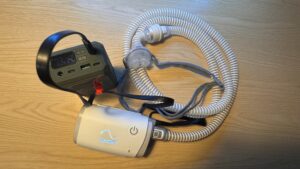
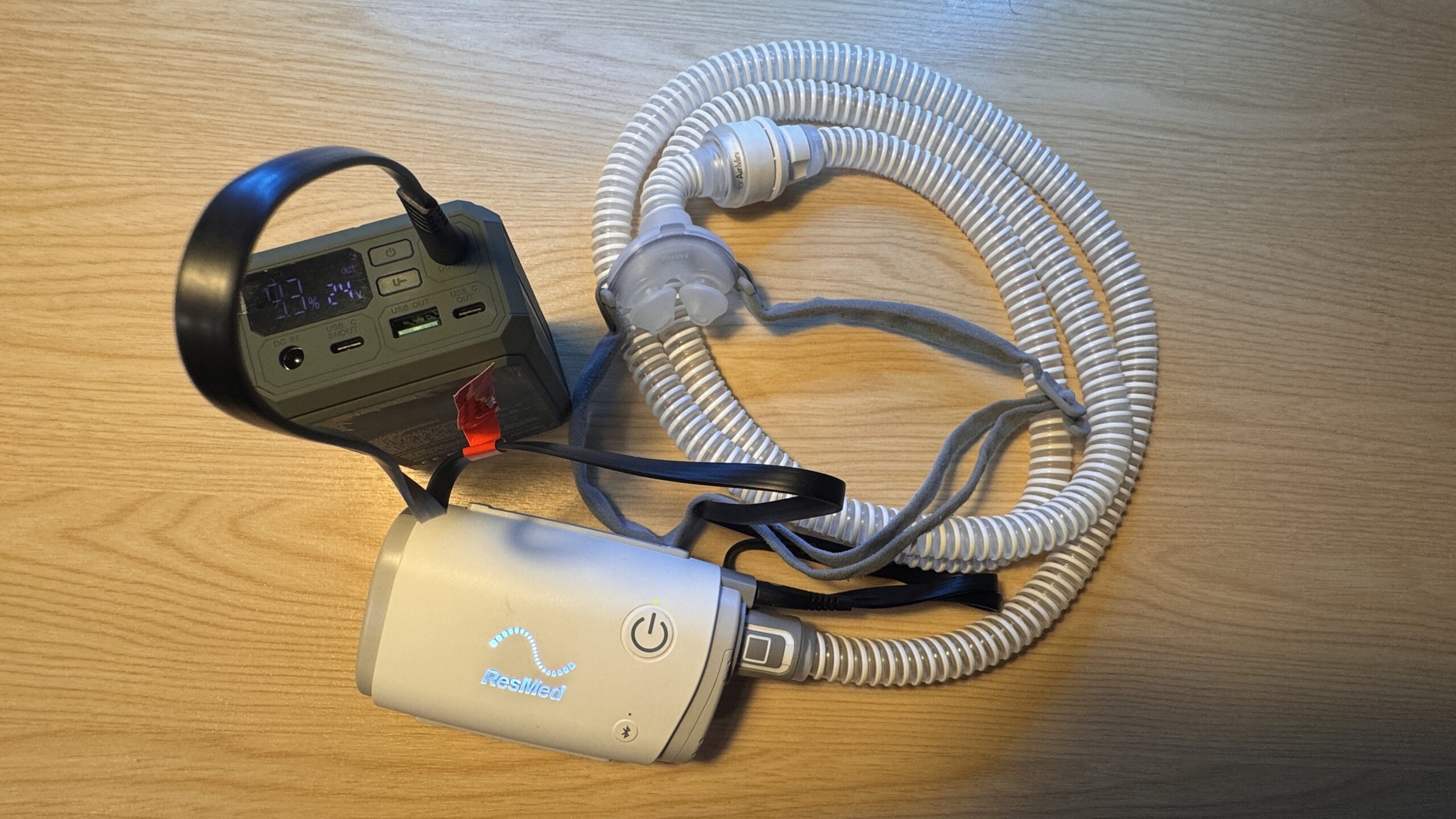
I have used my AirMini in the air several times, mostly on long-haul and red-eye flights. Typically, that is between the United Kingdom and the Middle East, and from the Middle East on to Asia. I have always run it from my battery, never from the seat outlet.
Below, I cover the rules, what eight airlines publish, the seat outlet, battery time and your humidifier. For carry-on rules, security and the rest of the trip, see my CPAP travel guide.
What the Rules Say About Using a CPAP on a Plane
Federal rules require US airlines to let you use a CPAP on aircraft with more than 19 seats. The same applies to foreign airlines on flights to, from or within the United States, with some exceptions.
However, your machine needs a manufacturer’s label showing it meets FAA requirements, so check yours before you fly. The airline can also ask for enough charged batteries to last “not less than 150% of the expected maximum flight duration.”
What Eight Airlines Say About Using a CPAP on a Plane
Outside the United States, each airline sets its own rules. These eight publish a clear position, and I checked each against its own website in October 2026.
| Airline | When you can use it | The seat outlet |
| Qantas | “At any time other than taxi, take-off and landing.” Battery-powered CPAPs can be used on all its aircraft. | Up to 150 W on most aircraft, 120 W in A380 Economy and 100 W in A380 Business and Premium. Request it at least 5 days ahead, with a Travel Clearance Form. |
| Emirates | “At any time other than taxi, take-off and landing.” | Every seat on its A380 and Boeing 777. On the A350, Premium Economy and Economy seats “do not have suitable power outlets.” |
| Japan Airlines | International flights only, “when the flight is level.” A CPAP cannot be used on domestic flights. | Up to 110V, 60Hz and 75 W, or 50 W at Boeing 777 Business center seats. |
| ANA | No separate timing rule published. Humidifiers cannot be used on board. | Seat outlets can be used, except during taxi, takeoff and landing. |
| British Airways | Medical equipment can be used “except during taxi, take-off, approach and landing.” No medical clearance needed for a CPAP. | “The maximum output of our in-seat power supply is 75 watts.” You need a DC adapter. |
| Air New Zealand | “Limited to the cruise phase of flight.” MEDA form Part 1 and 48 hours’ notice required. | 110V, 60Hz, for listed models only. The list stops at older machines such as the ResMed S9. |
| KLM | Batteries must last “at least 150 per cent of the expected maximum duration of your flight.” | “In-seat power outlets can’t be used for medical equipment because the power is unstable and not certified.” |
| Korean Air | Battery power only, for “at least 150% of your total flight time.” | “For safety reasons, you cannot use the onboard electrical power.” |
My CPAP airline policy guide covers the 71 airlines I have researched so far, including those that say nothing at all.
How to Use a CPAP on a Plane
These steps follow the rules above, so they work on most airlines that allow in-flight use.
- Check your airline’s CPAP policy before you fly, and give any notice or medical form it asks for.
- Check that your machine’s label or user guide shows it is approved for use on aircraft.
- Charge enough battery for at least 150% of the flight time, as US rules and several airlines require.
- Empty the water tub and switch the humidifier off for the flight, then use it again once you arrive.
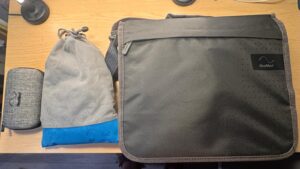
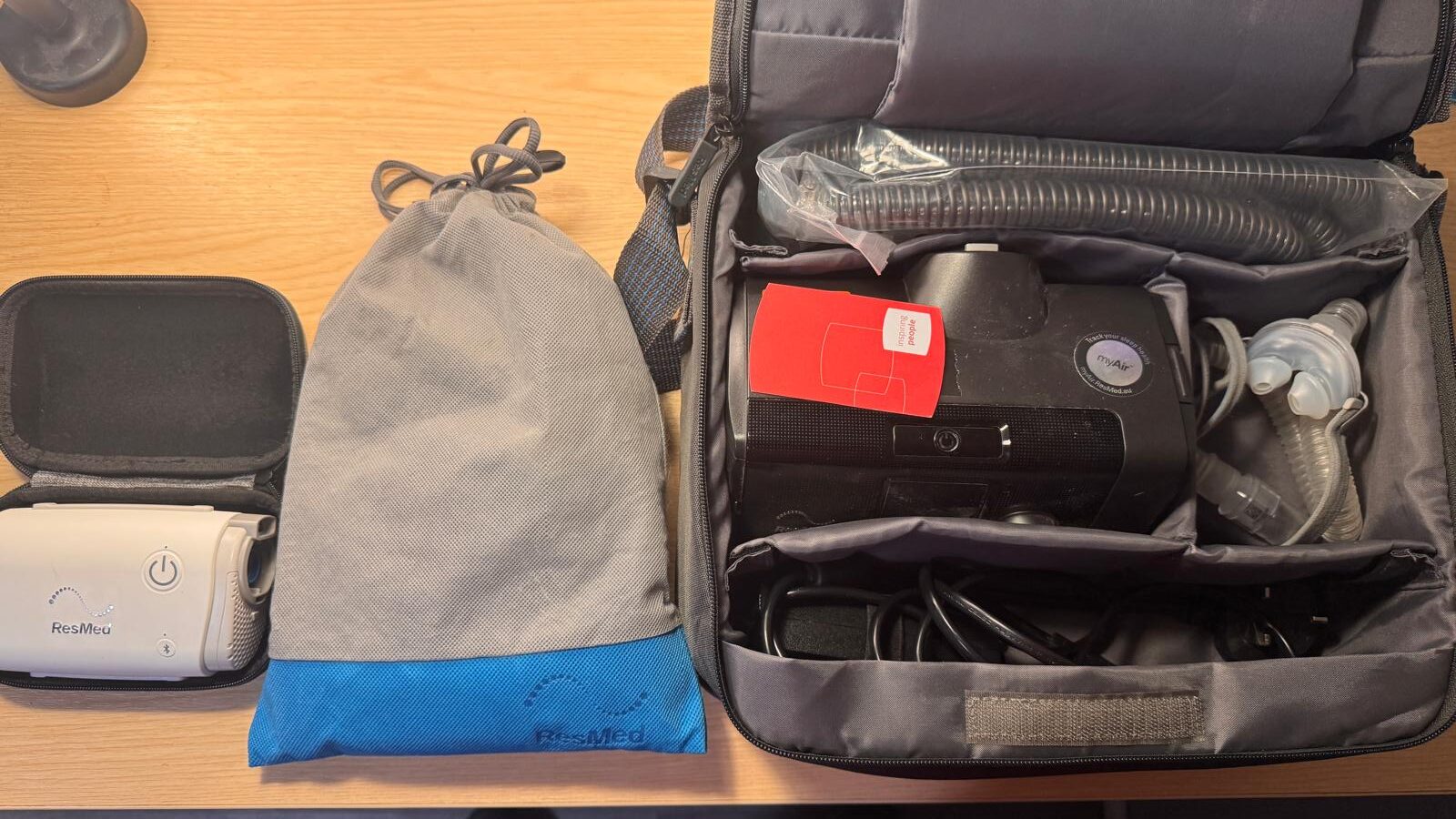
- Pack the machine, mask and battery in your carry-on, since spare batteries cannot go in a checked bag. My free CPAP luggage tag helps you spot your bag in a full overhead bin.
- Wait until the crew allow it after take-off, then put it away again before landing.
I have flown with my AirMini on multiple long-haul flights, and I start by leaving it in the overhead bin. It stays in my carry-on until after the first meal service, since trays, plates and cups soon clutter everything. Moreover, I don’t want to breathe in the residue of a fragrant curry that the crew just served. Nor do I want to inhale salad dressing that a neighboring passenger might have spilled in such a confined space.
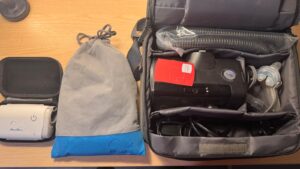
Once the meal service is over, the 40,000ft commuter traffic in the aisles to the restrooms usually calms down. Then I take my travel CPAP kit out of the overhead bin, with my CPAP battery, hose and cable. The DC to AirMini cable has a specific fitting, which differs from the DC to DC connectors for other machines. Next, I give my AirFit P10 for AirMini mask a wipe with an unscented wet wipe. If I used a standard HumidX at the airport hotel the night before, I switch to a HumidX Plus. I pop the HumidX Plus HME disk into the AirFit for AirMini chamber. After that, I put the unneeded case and the rest of my CPAP travel kit back in the overhead bin.
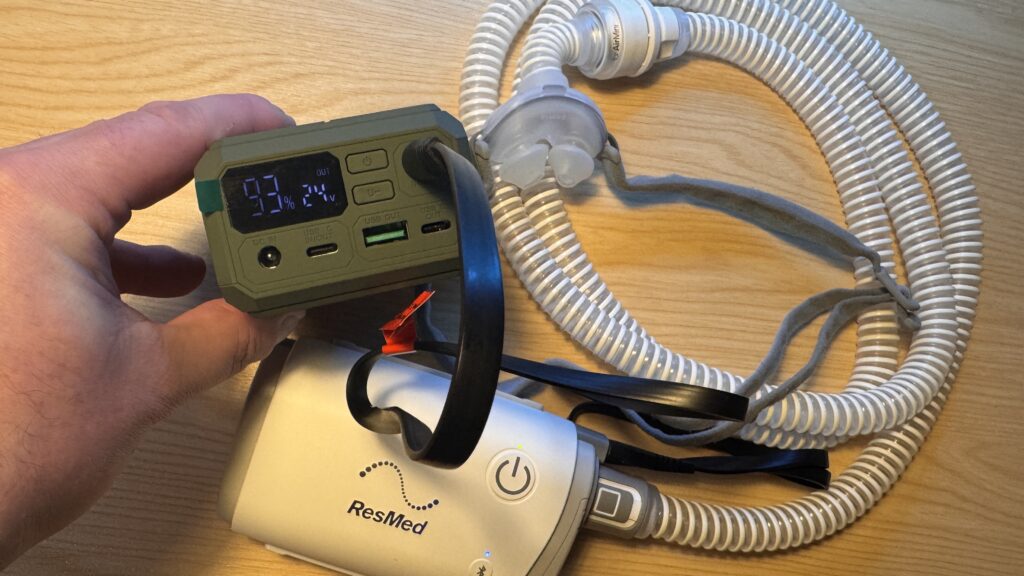
After getting comfortable, I connect the cable to the AirMini and attach the hose. Then I turn on the battery, set it to 24V and plug the cable’s DC end into DC OUT on the battery. Finally, I turn on the AirMini, which logs my therapy data only in the AirMini phone app. At present, the ResMed myAir phone app cannot import that travel CPAP data natively. Therefore, before a trip, I email my sleep clinic out of courtesy with the dates when my home machine will show no therapy data.
Can I Plug My CPAP Into the Seat Outlet?
Sometimes, but I would never plan a flight around it. Even the airlines that allow it warn that the power may not last. Qantas does not guarantee an “uninterrupted power supply through in-seat power.” Emirates, similarly, does not guarantee in-seat power “for the entire flight, including take-off and landing.”
Air New Zealand explains the reason, because its supply depends on “a number of factors including other devices plugged into the shared power supply.” In other words, your outlet shares its power with other passengers’ laptops and phones. That matches my experience, since I have found seat power unreliable in Emirates and Etihad Business Class, even for a phone. Sometimes it works, and sometimes it does not.
Where airlines say, the outlet is usually 110V at 60Hz. The AirSense 10, AirSense 11 and AirMini power supplies accept 100 to 240V, so they handle 110V without a converter. If you use another brand, check the label on its power supply. In addition, a seat USB port will not run a CPAP, since these machines need 12V or 24V DC.
How Much Battery Do I Need to Use a CPAP on a Plane?
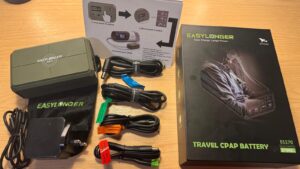
Plan for at least 150% of the flight time, which is what the US rules, KLM and Korean Air ask. For a 12-hour flight, that means carrying enough battery for 18 hours. My CPAP battery rules post explains which batteries you can take on a plane.
In my own testing, a 99.9 Wh battery ran my AirMini for 26 hours, which covers that comfortably. A full-size home machine uses roughly twice the power, so it needs a bigger battery for the same flight. A battery under 100 Wh also flies without airline approval under FAA, CAA and EASA rules.
Should I Use My Humidifier on the Plane?
I use a waterless HumidX Plus instead, and ResMed’s own figures show why. It lists the AirSense 10 AutoSet at 7 Wh for the machine alone, but 22 Wh with the humidifier. With a heated tube as well, that rises to 34 Wh, so the humidifier uses most of the power.
On the ground, I use the standard HumidX with my AirMini, but I switch to the HumidX Plus when I fly. The air on a plane is much drier, and the HumidX Plus is a massive benefit on a long-haul flight.
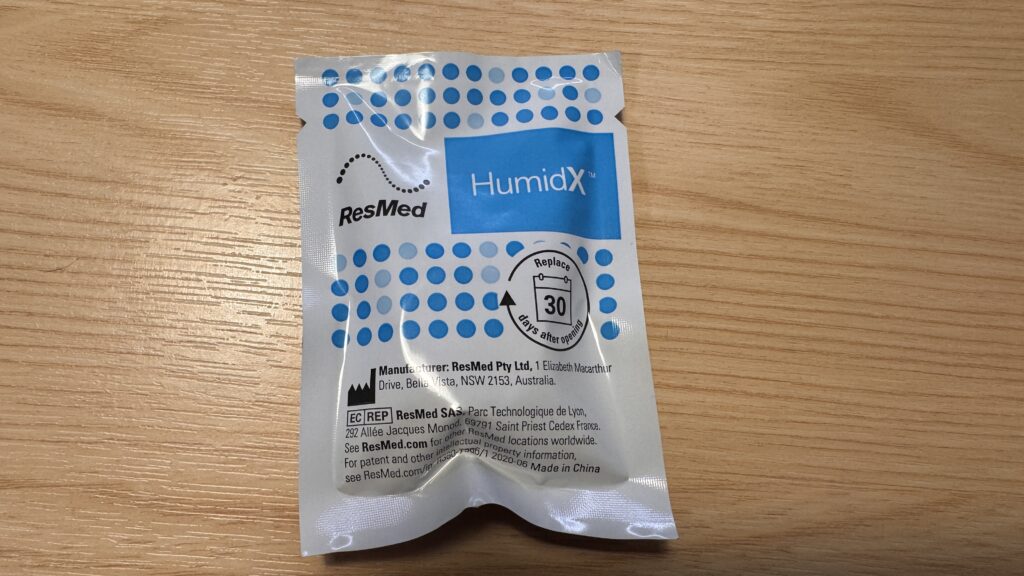
In my own testing on battery with no humidifier, my AirSense 10 averaged about 7.4 W. My AirMini, fitted with a waterless HumidX, averaged about 3.8 W, because the HumidX draws no power at all. Moreover, ANA does not allow humidifiers on board, and a water chamber is one more thing that can spill.
For everything else, see my full guide to traveling with a CPAP.