The CPAP battery rules changed worldwide on 27 March 2026, with new limits on power banks. If you treat sleep apnea with a CPAP and travel with a battery, those changes affect you directly. Nobody has resolved one part of them.
This article contains affiliate links and we may earn a small commission if you make a purchase through them. At no extra cost to you, this helps with the running costs of this blog.
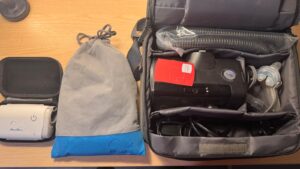
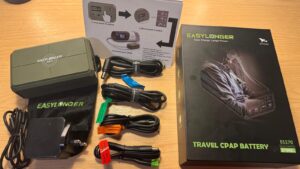
I own three Easylonger batteries, so I went through the regulators’ own wording rather than the summaries. My father runs a fourth, larger one in a motorhome, which turns out to sit the wrong side of the line for flying. Here is what actually changed, what it means in practice, and where the rules run out.
How the CPAP Battery Rules Changed on 27 March 2026
An Addendum to the ICAO Technical Instructions took effect on that date. Because national regimes follow ICAO, this applies on most international routes rather than in one country. Both IATA and the UK Civil Aviation Authority have implemented it.
Five provisions matter to CPAP travelers. In the regulators’ own words, power banks:
- must be carried in carry-on baggage
- must be individually protected when not in use
- must not be recharged on board the aircraft
- should not be used to charge other portable electronic devices in flight
- are capped at a maximum of two power banks per person
The CAA adds a practical note for passengers: “You may be asked to put power banks in your seat back pocket rather than in an overhead locker.”
None of this came out of nowhere. EASA had already flagged the risk in Safety Information Bulletin 2025-03, issued in May 2025, which recommended prohibiting the use of power banks to charge devices in flight. It also warned crews about storing lithium batteries in overhead bins near oxygen systems.
The Practical Consequence for CPAP Users
Two of those provisions change how you plan a long flight.
You can no longer top up a battery from an in-seat socket. Previously, on a long-haul flight with working seat power, you could run the machine and recharge as you went. The rules now prohibit that approach outright. Therefore your battery has to hold enough charge for the whole night on its own.
Carrying a main battery plus a spare puts you at the limit immediately. Two is the cap, so a third is not an option.
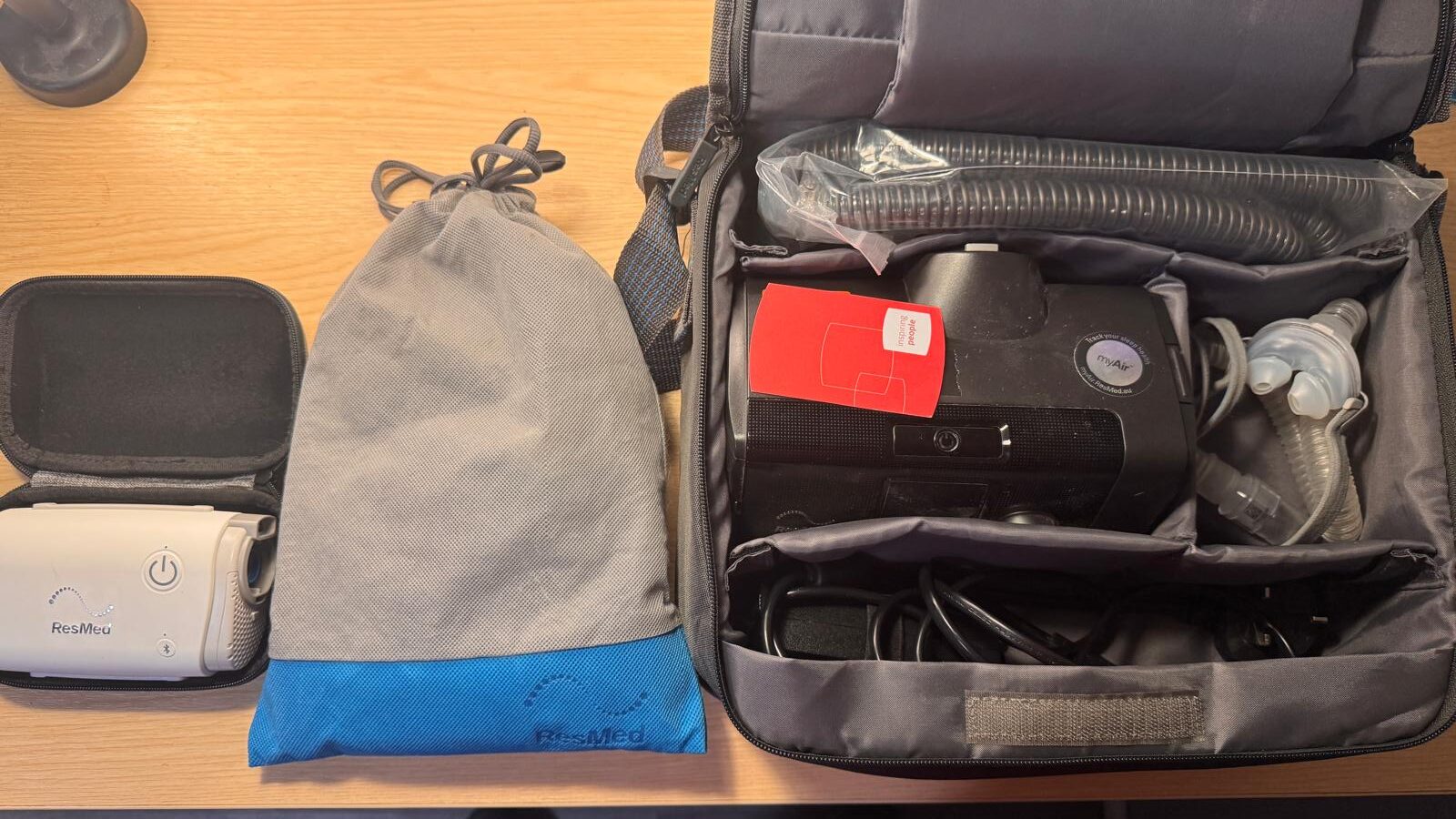
The third provision is easy to satisfy but easy to forget. You must protect each battery individually against short circuits when not in use. A separate bag or pouch per battery does it, and taping the terminals is the alternative the rules explicitly allow.
The Watt-Hour Bands, Which Did Not Change
The thresholds themselves did not change, and they remain the numbers that decide whether your battery flies at all.
| Capacity | Cabin | Checked | Spares | Airline approval |
| Up to 100 Wh | Yes | In equipment only | IATA caps spares at 20, cabin only | Not required |
| 101–160 Wh | Yes | In equipment only | Maximum 2, cabin only | Required in advance |
| Over 160 Wh | No | No | No | Cannot be carried at all |
CPAP Battery Rules Use Watt-Hours, Not Milliamp-Hours
Note that these are watt-hours, not milliamp-hours. The conversion is straightforward:
Wh = (mAh ÷ 1000) × V
The FAA gives a worked example: a 12-volt, 8 Ah battery is 12 × 8 = 96 Wh.
Why watt-hours? Because milliamp-hours are meaningless without a voltage. Its own manufacturer labels my Easylonger ES400 Air both as “3.7V / 40,000mAh / 148Wh” and as “14.8V / 10,000mAh / 148Wh”. Same pack, described at cell level and at pack level. The milliamp-hour figure changes fourfold; the watt-hour figure does not. Watt-hours measure stored energy, and stored energy is what determines fire risk.
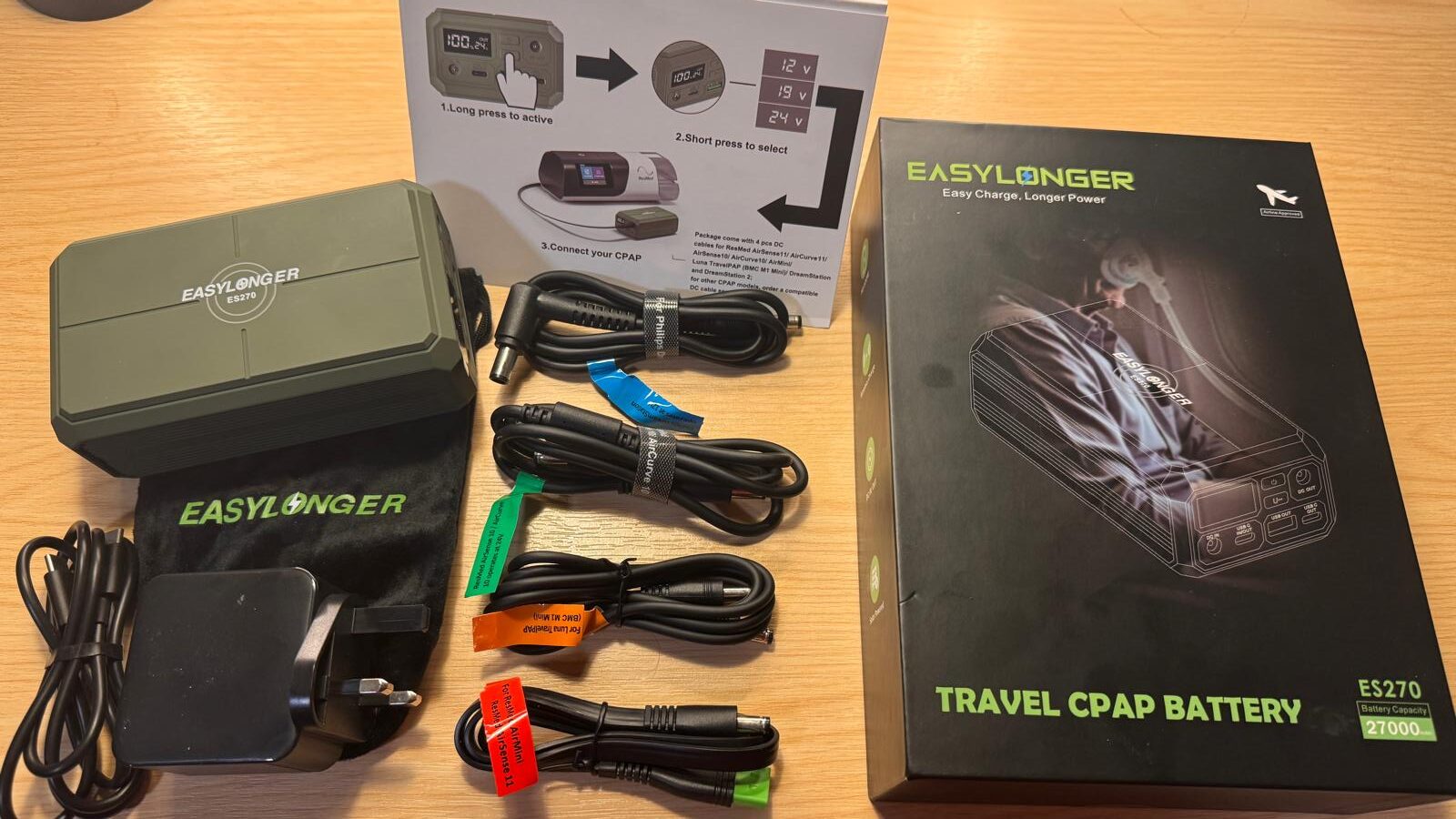
Where the common CPAP batteries fall: the Easylonger EL240 is 88.8 Wh and the ES270 is 99.9 Wh, so both fly without asking anyone. The ES400 Air at 148 Wh sits in the approval-required band, so you cannot assume it will fly.
Then there is the band nobody warns you about until it is too late. The batteries that give you the most nights are the ones you cannot take on an aircraft at all. An Easylonger ES720 is 276.48 Wh and an ES960 is 297.6 Wh. Both are excellent off-grid batteries, and both are well over the 160 Wh ceiling. No approval process exists for them, because there is nothing to approve. The rules simply forbid them.
That catches people out, because these batteries sell into the same market and sit beside the smaller ones on the same shelf. So buy by where you are going, not by how many nights the box promises.
The Fly-Drive Trap
The trip that springs this trap is the fly-drive. You book a motorhome tour of New Zealand, or the Rockies, or Route 66. You sensibly buy a big battery for the off-grid nights. Then you discover it cannot board the plane that gets you there, and checking it into the hold is not the workaround, because above 160 Wh the rules ban it from the hold as well as the cabin. The same applies to a fly-cruise, where you fly to the port and the battery has to clear the airline first.
The answer is usually that you don’t need it. A hired motorhome or camper van already has a leisure battery, and most sites you would book on a touring itinerary have electric hookup. So the sensible kit for a fly-drive is a sub-100 Wh battery that clears the airline without a conversation, topped up from the vehicle or the hookup as you go. Save the big battery for trips you drive to from home. If you genuinely need one at the far end, hire or buy it at the destination rather than trying to fly it.
One correction worth making, since it appears in marketing copy. Easylonger describes the ES270 as “FAA/TSA-approved”. That phrasing is not accurate. The FAA does not approve or certify individual battery models. It sets a watt-hour threshold, and the ES270 sits below it. The outcome is the same, but the mechanism matters when an agent asks you a question.
The Question Nobody Has Answered
Here is the part I cannot resolve, and I would rather tell you that than guess.
Does a purpose-built CPAP battery count as a “power bank” for the new two-unit cap?
The argument that it does is straightforward. IATA describes a power bank as “an easily carried universal external power source, capable of providing power to multiple devices such as mobile phones”, and treats power banks as spare batteries. A detachable CPAP battery with a USB-C output looks exactly like that. On a literal reading, it is one, which means it counts toward your two, cannot recharge in flight, and must ride in the cabin.
The argument that it does not is equally real. The same rulebooks contain separate, more generous provisions for portable medical electronic devices. The rules permit lithium metal batteries above 2g for medical devices, but cap ordinary devices at 2g. Disability access regulations point the same way. A battery that exists solely to run a prescribed therapy device is not obviously the same object as a phone charger.
No published source I can find resolves it. I have looked through the ICAO Addendum, the IATA guidance to operators, the CAA’s passenger and industry pages, and the EASA bulletin. It is not there.
Interestingly, one airline appears to have spotted the ambiguity and drafted around it. Emirates requires that CPAP spare batteries “must be device specific and must not be capable of charging other devices, such as functioning as a power bank.” That is a sensible test, but Emirates is one carrier, not the rule.
What to Do While the CPAP Battery Rules Stay Unclear
So my advice is practical rather than legal. Email your airline before you travel. Describe the battery by its watt-hour rating, say that it powers a prescribed medical device, and ask three specific questions:
- whether it counts toward the power bank limit?
- whether you may use it in flight? and
- whether it needs approval?
Then carry the email reply. That email is worth more at a gate than any blog post, including this one.
Airlines with Stricter CPAP Battery Rules
Several carriers introduced power bank restrictions of their own during 2025 and 2026. On these airlines, the CPAP battery rules go further than the international baseline, and theirs bite before ICAO’s do.
- Thai Airways, from 15 March 2025: use of power banks onboard prohibited. Maximum two under 100 Wh; over 100 Wh forbidden entirely.
- Cathay Pacific, from 7 April 2025: cannot charge devices from a power bank, and cannot charge a power bank from in-seat power. Cathay does publish an exception for “Batteries for essential medical aids or life-saving purposes only”, which is the closest thing to an answer on the question above.
- Rex, from 15 December 2025: “Power banks must not be used on board Rex aircraft at any time.” Also: “Bags containing power banks and spare batteries must not be stowed in the overhead locker.”
- Singapore Airlines and Scoot, from 15 April 2026: maximum two per passenger, and no charging from in-seat power or USB ports during the flight.
- Korean Air: the hardest carrier in this set to plan for. It prohibits aircraft power for medical devices entirely, caps onboard medical device batteries at 160 Wh, and bans storing batteries in the overhead bin. It does, however, explicitly permit “POC and CPAP devices … with lithium batteries over 2g up to 8g”.
- Qantas: “Lithium batteries exceeding 160Wh are forbidden to be carried on any Qantas aircraft.”
Sizing a Battery: The Nameplate is Not the Answer
Before you can judge whether a battery is big enough, you have to know what a night actually costs you. Almost everyone works this out from the wattage printed on the machine, and almost everyone lands miles off.
The label gives you a maximum, not a nightly average. A CPAP spends the night idling at your therapy pressure, not sitting at full blast. So the real figure is far lower, and with humidification off it is lower still.
What Three Machines Actually Drew
Here is what three machines actually drew, measured by running them until the battery was flat rather than by reading a spec sheet.
| Machine | Nameplate | Battery | Nights | Per night |
| ResMed AirMini, on HumidX | 6.3W typical | ES400 Air, 148 Wh | 4.5 | ~33 Wh |
| ResMed AirSense 10 AutoSet, no humidification | 53W typical, 104W peak | ES400 Air, 148 Wh | 3.5 | ~42 Wh |
| Philips DreamStation Auto, humidification off | 12V / 6.67A, so 80W | ES720, 276.48 Wh | 4.5 | ~61 Wh |
The first two are my own machines. The third is my father’s, which he runs in a motorhome.
Now compare the two columns. The nameplates run 6.3W, 53W and 80W, a thirteenfold spread. The measured nights run 33 Wh, 42 Wh and 61 Wh, which is not quite double from end to end. The order holds, but the scale collapses.
Sizing from the nameplate would have told you an AirSense 10 needs over 400 Wh a night. It needs about a tenth of that. It would also have told you the AirMini needs 50 Wh, when mine settles nearer 33.
How to Size Your Own Battery
So size from watt-hours per night, with margin, and ignore the wattage on the case. Around 60 Wh a night covers every machine in that table, so it is a safe planning figure for a full-size CPAP with humidification off. Add a night of headroom on top, because a colder room, a higher pressure or an ageing battery all cost you something.
If you would rather think in watts, divide by your own hours. Those three work out near 4W, 5W and 8W across an eight-hour night. But hours vary more than people admit, which is exactly why I have given you watt-hours per night instead.
One caveat I will not paper over: these are three machines, at our pressures, with humidification off. Your figure will differ. So run your own battery flat at home before you rely on it somewhere that matters. In fact, my father did precisely that with the ES720 before he took it away, and that is the right order to do it in.
What This Means When You Choose a Battery
Put the CPAP battery rules and the products together, and the conclusion is simple.
Check the voltage your machine needs, then set the battery to match. This is the step that strands people, and it is not the same answer for everybody. Most CPAP batteries have a selectable DC output, because different machines want different things. My Easylonger EL240 and ES400 Air each offer four settings: 12V, 16.5V, 20V and 24V.
Both my ResMed machines need 24V. An AirSense 10 wants 24V at 3.75A, an AirMini 24V at 0.83A, an AirSense 11 24V at 2.71A. My father’s Philips DreamStation is not a 24V machine at all. Its label reads 12V, 6.67A, so he sets his battery to 12V and a ResMed setting would be no use to him whatsoever.
Do not assume, and do not copy a setting from a forum post. Turn your machine over and read the label on the underside. It prints the voltage and the current the machine expects, and that is the number the selector has to match. You can set it at home, but my Easylonger batteries switch off within 10 minutes with nothing connected. So set the voltage when you plug your machine in, just before you use it.
Buying and Packing Under the CPAP Battery Rules
Buy under 100 Wh if you fly regularly. A battery below the line travels without approval, without a phone call and without an argument. That is why Easylonger engineered the ES270 to 99.9 Wh rather than a round 100.
Treat anything between 101 Wh and 160 Wh as a planning decision rather than a purchase. The rules do not ban it, but it needs written airline approval for every flight, and you may carry only two spares.
Never put a spare battery in the hold. This is not advice, it is prohibition. The CAA states it directly: “spare lithium batteries must be carried in the cabin. They are not permitted in hold baggage.”
Charge before you fly, and expect to prove it works. UK government guidance is blunt: “If your device does not switch on when requested, you will not be allowed to take it onto the aircraft.” That applies to the battery as much as the machine.
Finally, keep the manufacturer’s specification sheet with the battery. It is the document that answers the only question a check-in agent can actually refuse you over: what is the watt-hour rating of that pack. A letter from your doctor does not answer it.
Before you pack, grab my free CPAP luggage tags, which mark your bag as medical equipment.
Because airlines add their own limits on top, check your airline’s published policy before you fly.
For more on traveling with a CPAP, such as security, hotels and camping, see my full guide.
Last verified: 20 September 2026. Lithium battery rules have moved twice in eighteen months, so I re-check this page and date each revision.