As a CPAP user and travel blogger, I created this CPAP travel guide. It answers the questions I keep seeing other sleep apnea travelers ask about taking, using and powering a CPAP away from home.
This article contains affiliate links and we may earn a small commission if you make a purchase through them. At no extra cost to you, this helps with the running costs of this blog.
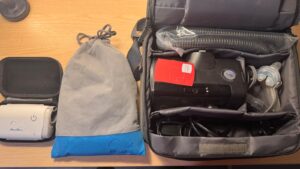
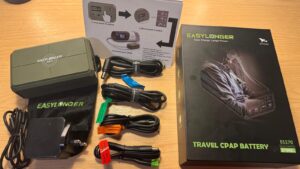
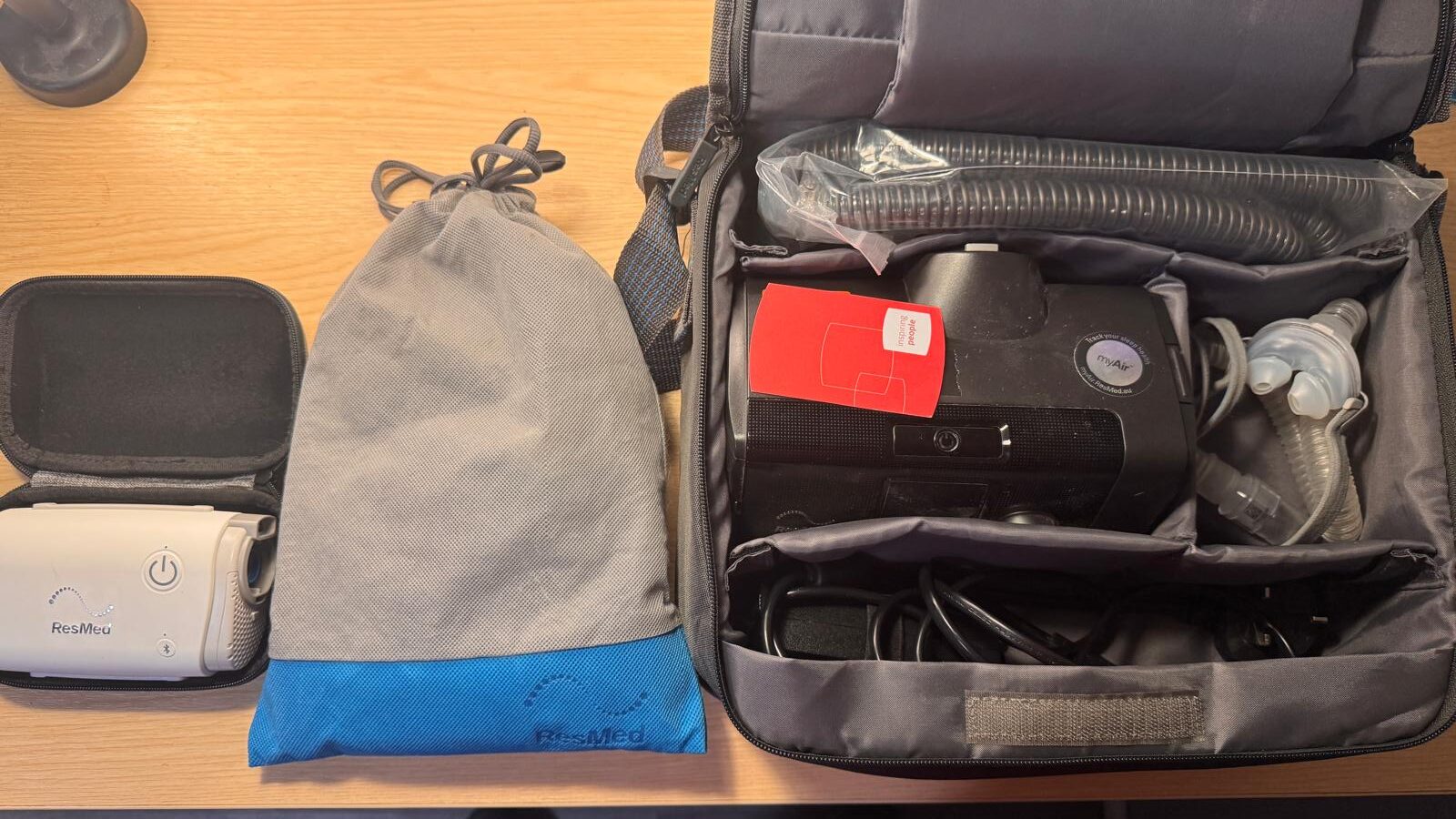
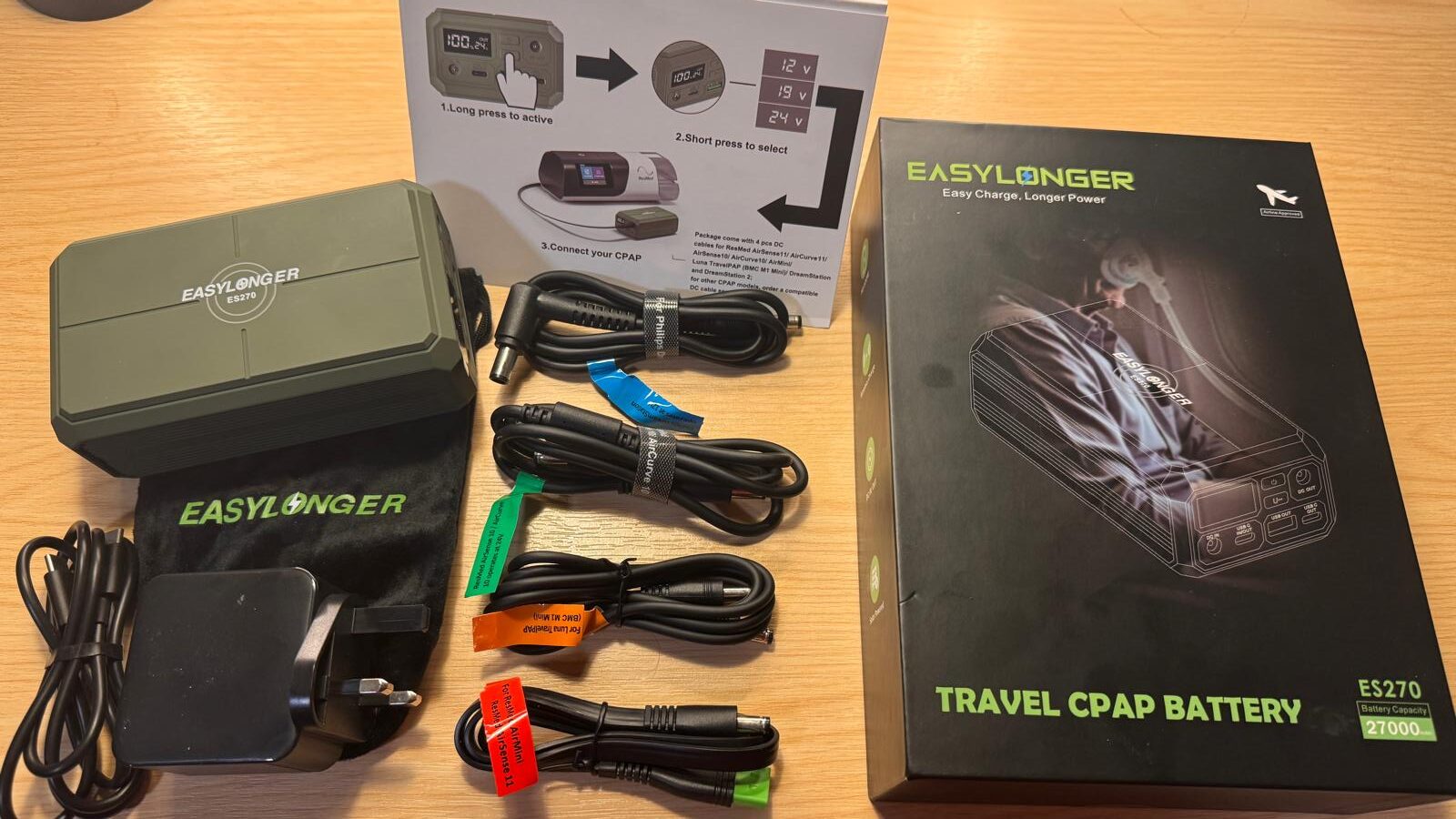
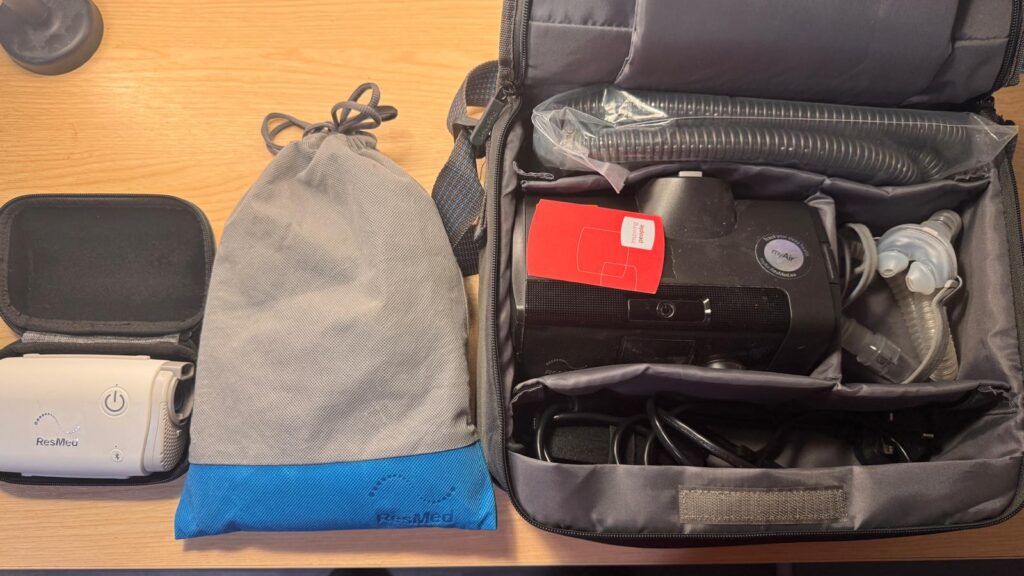
I own a ResMed AirSense 10 AutoSet and a ResMed AirMini, both running an AirFit P10 nasal pillows mask. I also carry the genuine ResMed AirMini Travel Case. For power away from the mains I own Easylonger batteries, an EL240 and an ES400 Air. Easylonger has also sent me an ES270 to test and review.
I have traveled with my AirSense 10 throughout the United Kingdom, and on short-haul routes to Jersey and Ireland. For long haul I typically leave it at home and take my travel CPAP. It takes up less space and there is less to carry.
These rules vary by country, by regulator, and sometimes by individual airport terminal. Lithium battery limits, medical-device baggage rules and airport liquid rules all differ. I’ve separated the global baseline from the national variations throughout this CPAP travel guide. Wherever you’re flying from, you’ll find the rule that applies to you.
One thing changed recently, and it matters more than anything else on this page. New international rules on lithium batteries and power banks took effect on 27 March 2026. They change how many batteries you can carry, where they must travel, and whether you can recharge one in flight.
Each question in this CPAP travel guide gets a straight answer.. Where a question deserves more than a straight answer, I have written a separate guide and linked to it.
Can I Take a CPAP Machine on a Plane?
Yes. Every airline I have checked for this CPAP travel guide permits a CPAP in the cabin. Most carry it free of charge too, as an extra item on top of your hand baggage allowance. In the US, carrying a CPAP isn’t an airline courtesy. It’s federal law. Under the Air Carrier Access Act, the Department of Transportation requires airlines to let you bring and use a CPAP in the cabin. The machine must carry the manufacturer’s label stating it meets FAA requirements. The DOT is equally clear on baggage: “Assistive devices do not count to your baggage limit.”
Pack holiday items in the same bag, though, and the airline can count it. The rule covers US airlines and foreign airlines on any flight to or from a US airport. Airlines can still set conditions, such as enough battery for 150% of the flight. However, no federal rule requires a doctor’s statement for a CPAP. That requirement applies only to portable oxygen concentrators.
British Airways states it plainly: “Medical clearance is not needed to travel with or use a CPAP Machine for sleep apnoea on board our aircraft.”
Outside the US, the concession is airline policy rather than law, so it varies. easyJet and Jet2 want at least 48 hours’ notice. Ryanair carries it free only once you hold a medical baggage waiver letter. The UK Civil Aviation Authority sets no requirement for a free allowance at all. It simply tells you to contact your airline first.
→ CPAP Policy by Airline: 71 Worldwide Carriers Compared, with each airline quoted on notice periods and documentation requirements..
Does a CPAP Count as Hand Luggage?
Usually no. Most airlines treat a CPAP as medical equipment carried in addition to your cabin bag. That means it does not count against your one-bag limit.
Three conditions typically attach. Size limits still apply, both easyJet and Jet2 both cap medical equipment at 56 × 45 × 25 cm. Notification deadlines are real, and missing one lets the desk refuse the extra piece. And the concession covers the machine and its accessories, not a second holiday bag.
→ Free Printable CPAP Luggage Tags, in nine languages and six colors, to mark your bag as medical equipment.
Should I Put My CPAP in Checked Luggage?
No. Carry it in the cabin. If your machine travels with a battery, this is not merely advice: spare lithium batteries are prohibited in the hold. The CAA is unambiguous, “spare lithium batteries must be carried in the cabin. They are not permitted in hold baggage.”
Beyond the battery rule, a CPAP is a precision blower that hold baggage will not treat kindly. A delayed bag also means nights without therapy. Replacing a machine abroad often needs a prescription too. Since most airlines carry it free in the cabin anyway, checking it buys you nothing.
How Do I Take a CPAP Through Airport Security?
Expect to take the machine out of its bag and put it through the X-ray in its own tray. Leave the mask and tubing in the case. UK government guidance states it directly: “Medical equipment is screened separately.”
The detail differs by country. The TSA’s own two pages disagree on whether the machine must leave its case, so plan for the stricter version. TSA PreCheck is the exception, since it lets the machine stay in the bag entirely. EU screening runs under Regulation (EU) 2015/1998. UK airports now diverge on liquids too. Heathrow and Gatwick allow two liters, while Manchester and Stansted hold at 100 ml.
Do I Need a Doctor’s Letter or Prescription?
No jurisdiction I have checked for this CPAP travel guide legally requires documentation to carry a CPAP. ResMed’s current travel guidance says so outright: “Thanks to growing awareness of sleep apnea, it’s no longer necessary to show a medical statement when going through security with a CPAP device.”
There is one real documentation requirement, and it attaches to liquids rather than to the machine. UK rules require a doctor’s letter or prescription copy for essential liquid medicines over 100 ml. Most airlines recommend a letter without requiring one. easyJet states plainly that it does “not require a letter from your healthcare practitioner” for CPAP machines.
What I actually carry is a printed letter and a fit-to-travel letter where one is required. I also carry the Easylonger paperwork for the batteries. That last item is the one most travelers overlook. It is also the one a check-in agent can actually refuse you over: the watt-hour rating of that battery pack.
I have been asked for the battery paperwork only once, by a gate agent at Istanbul Airport. Although, when I was boarding the fourth of four Turkish Airlines flights, and nobody had asked on the first three. I gave her the evidence. She had still convinced herself the machine, rather than the battery, was an oxygen concentrator, and tried to deny boarding. Her team leader reprimanded her, said ‘CPAP OK’ and sent me through.
Can I Use My CPAP During a Flight?
Yes, on almost every airline. But the approval regime is not the one most people assume, and you will need your own power. A CPAP is not covered by the portable oxygen concentrator approval list. What matters is the manufacturer’s label, and ResMed states that the AirSense 10, AirCurve 10 and AirMini “meet Federal Aviation Administration (FAA) requirements for all phases of air travel.”
Before you use one in the air: humidification off, Airplane Mode enabled. If your machine has a water tub, keep it in place but completely empty. If it doesn’t, like a ResMed AirMini running HumidX, there is nothing to empty at all. Delta requires battery capacity covering 150% of the flight time. Ryanair requires prior approval and a fit-to-fly form to use a respiratory device in flight.
I have used mine in the air several times, mostly on long-haul and red-eye flights. Typically that is between the United Kingdom and the Middle East, and from the Middle East on to Asia. I find I cannot sleep without it now. So yes, if you need CPAP, it is 100% worth using.
What Battery Size Can I Fly With?
Under 100Wh you are fine everywhere. Between 100Wh and 160Wh you need your airline’s approval in advance. Above 160Wh you cannot carry it at all.
Watt-hours decide whether a battery may fly. Voltage decides whether it can run your machine at all. Both ResMed machines need a 24V DC output, so check that first.
Here is the part that catches people out, and it has nothing to do with cars. Most CPAP batteries have a selectable DC output voltage, and you have to set it to 24V yourself. My Easylonger EL240 and ES400 Air each offer four options — 12V, 16.5V, 20V and 24V. Those lower settings exist for laptops, not for CPAP machines. Select the wrong one and your machine simply will not run.
Check the selector carefully before use.
Every battery figure in this CPAP travel guide is in watt-hours, not milliamp-hours. The conversion is Wh = (mAh ÷ 1000) × V. Watt-hours measure stored energy, which is what determines fire risk, and that is why regulators use them. Of the batteries I own, the Easylonger EL240 is 88.8Wh and the ES270 is 99.9Wh. Both sit under the line. The ES400 Air at 148Wh needs approval.
Can I Take a CPAP Battery on a Plane?
Yes, in the cabin only — and the rules changed on 27 March 2026. An Addendum to the ICAO Technical Instructions now applies internationally. Power banks must travel in carry-on baggage and be individually protected. They must not be recharged on board, and should not be used to charge other devices in flight. Each traveler is capped at two per person.
The CAA adds that you may be asked to keep them in the seat-back pocket rather than an overhead locker. The practical consequence is real. You can no longer plan to top a battery up from an in-seat socket on a long flight.
There is an unresolved question underneath this. Does a purpose-built CPAP battery count as a “power bank” for the two-unit cap? No published source answers it.
→ Is a CPAP Battery a Power Bank? The March 2026 Rules Explained, showing the regulators’ exact wording, the medical-device exemptions that point the other way, and how to get your airline’s position in writing.
Can I Plug My CPAP Into an Aircraft Power Socket?
Do not plan around it. British Airways publishes its limit: “the maximum output of our in-seat power supply is 75 watts.” ResMed, meanwhile, publishes a peak consumption of 104W for the AirSense 10. The machine can want more than the socket can give. That is why BA tells CPAP users to bring a battery.
A ResMed AirMini draws 6.3W typically, against the ResMed AirSense 10’s 53W. That gap is the strongest practical argument for traveling with the smaller machine. American Airlines puts it bluntly: “Don’t depend on the availability of a power outlet to support your device.” Emirates cannot guarantee in-seat power for a whole flight.
CPAP Travel Guide for International Travel
The machine travels everywhere. What changes at the border is the power, the water and the paperwork.
Battery watt-hour bands follow ICAO, so 100Wh and 160Wh are the numbers almost worldwide. What varies is mains voltage. It runs 100–127V across the US, Canada and Japan. Across the UK, Europe, most of Asia and Australasia, it runs 220–240V. Plug type and airport liquid rules vary too, along with how easily you can buy distilled water. So does how likely you are to be asked for documentation.
Do I Need a Voltage Converter or Just a Plug Adapter?
A plug adapter. Almost certainly not a converter. Every current ResMed power supply, the AirSense 10, AirSense 11 and AirMini, accepts 100–240V at 50–60 Hz. That covers essentially every country you will visit.
Do not confuse the mains figure with the machine’s own voltage, though. The brick accepts 100–240V AC, but what it hands the machine is 24V DC. That 24V figure is the one that matters the moment you leave the mains behind. A 12V vehicle socket and an ordinary USB power bank cannot supply it directly.
Two other things matter. Use a fused adapter rather than the cheapest one in the airport shop. Avoid running a CPAP through a car-style inverter where you can. Converting DC to AC and back to DC inside the brick wastes battery. Going DC to DC is far more efficient, which is why ResMed sells 24V DC converters for both machines.
What Happens if There Is No Socket Beside the Bed?
Carry a short extension lead. Three meters of cheap flex cable solves most of this problem and weighs nothing.
Rooms put the only reachable socket behind a desk on the far wall. Older European hotels wire the bedside socket to the master light switch, so it dies when the lights go off. Many hotels across Asia and the Middle East cut room power when you remove the key card. None of this shows up in the listing photos, and a battery removes the problem entirely.
How Do I Travel With Distilled Water?
Only if you actually use a humidifier chamber, and plenty of CPAP users don’t. I run my ResMed AirMini on HumidX, a waterless heat-and-moisture exchanger, and my ResMed AirSense 10 with no humidification at all. Neither one has ever needed distilled water from me. In my experience at a UK sleep clinic, a humidifier chamber isn’t automatically issued, and plenty of people manage without one. If that’s you too, this section of the CPAP travel guide doesn’t apply, and you can skip ahead to how HumidX works on the AirMini.
If you do use a chamber: don’t fly with it full. Empty it and buy water at your destination. ResMed’s own instruction is to empty it regardless: “The tub should always be emptied before transporting, to avoid water damage.”
No security authority in the UK, US or EU names distilled water as an exempt item. The exemption has to be argued instead, as a medically necessary liquid. In the US that works but you must declare it at the checkpoint. Where distilled water is genuinely unavailable at destination, ResMed’s published fallback is bottled or drinking-quality water, not tap water.
Can I Use My CPAP in Hotels Abroad?
Yes, and it is straightforward once power and water are solved. A CPAP draws less current than a hairdryer, so hotel wiring is rarely the obstacle.
If you use a humidified chamber, ask housekeeping for distilled or purified water. Across much of Asia this is an ordinary request. Never fill the chamber from a tap in a country where you would not drink the water. And noise is rarely the issue people expect. ResMed publishes 25 dBA for the AirSense 10, rising to 27 dBA with humidification, and 29 dBA for the AirMini.
I have started noting socket positions and bedside space when I stay in hotels. My CPAP has to sit somewhere and plug in. I now include both in hotel reviews on AspieTravels, and I have posted about it on the AspieTravels Substack.
Should I Buy a Travel CPAP?
It depends on how much you travel and whether your humidifier is doing real work for you. This is the question most sleep apnea travelers reach eventually, and the honest answer turns on two numbers. The raw comparison: a ResMed AirMini is 300g and draws 6.3W typically. A ResMed AirSense 10 with its tub is 1,248g and draws 53W. On battery, that difference decides everything.
Against that, the AirMini is approx £670 plus VAT in the UK for the device alone. It also restricts your mask choice, because it has no standard 22 mm hose port.
Then there is HumidX. ResMed specifies replacement within 30 days of opening the sealed pack, so it is a consumable rather than a one-off. In my case it is not optional either: the AirMini delivers air dry enough that I cannot sleep without one. Treat it as a fixed running cost when you compare prices.
ResMed is not the only option, and I would not want anyone to assume it is. Fisher & Paykel, the BMC M1 Mini Auto, Löwenstein Prisma SMART and Transcend all belong on the list.
CPAP Travel Guide: Traveling With a ResMed AirMini
This is the travel machine I own, and the one this CPAP travel guide is written around. At 300 g and 136 × 84 × 52 mm, it disappears into a bag. Its waterless HumidX humidification also removes the distilled water problem entirely.
HumidX is not optional for me. The AirMini blows such rapid dry air into my AirFit P10 mask that I cannot sleep without the HumidX disk in place. That is worth knowing before you buy. It turns a waterless humidifier into a running cost rather than an accessory.
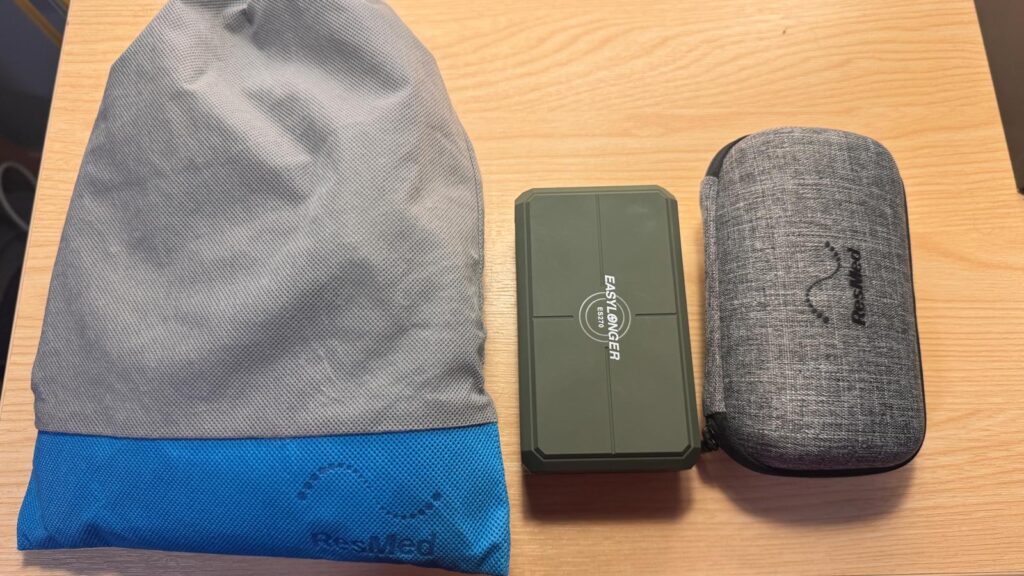
My one travel trick. I carry the machine in the genuine ResMed AirMini Travel Case, which holds just the AirMini and nothing else. I keep one of those little silica gel sachets in the case with it, which takes away any lingering vapour. It costs nothing and it is the single tip I find myself repeating most often to other CPAP travelers.
The other thing nobody tells you: the AirMini has no battery of any kind. ResMed does not sell one for it either. ResMed’s own answer is direct: “it must be plugged into power to operate.” Its battery range covers the AirSense 10 and AirCurve 10 only. Portable power for an AirMini means third-party.
The first trip I took mine on was long haul to the Philippines, I was surprised how compact it was compared to my AirSense 10, and looking into it in more detail, I understand they are essentially the same, but the AirSense 10 has acoustic foam that the AirMini does not. That said, it is far easier to pack and barely has any weight. The only noticeable difference I find with the AirMini from the AirSense 10 in the morning is that i feel my airway is clearer. Moreover, I don’t really notice the noise it generates from airflow in the slimline tube as I fall asleep quickly, so it doesn’t annoy me.
How I Power My CPAP While Travelling
I run the ResMed AirMini from Easylonger batteries, and the number that matters is 99.9 Wh.
The batteries I own: Easylonger EL240 at 88.8 Wh, ES270 at 99.9 Wh, and ES400 Air at 148 Wh. The number that matters on the ES270 is 99.9 Wh. It sits just under the 100 Wh threshold, so it flies without anyone’s approval. The ES400 Air is the bigger battery but lands in the approval-required band.
Easylonger claims the ES270 gives “up to 8–10 hours” with a ResMed AirMini. It claims “approximately 6–8 hours” with an AirSense 10, both with humidification off. Neither claim states the pressure setting behind it, so neither is reproducible as published.
I have now tested the ES270 overnight instead of quoting the box. From a full charge it ran my ResMed AirSense 10 AutoSet for two nights, 6.5 hours then 7 hours. That is 13.5 hours in total, or roughly 7.4 W. The same battery then ran my ResMed AirMini with a HumidX for four nights of 6.5 hours. That is 26 hours, or roughly 3.8 W.
Both machines are set to a 5 to 20 range with a 10 minute ramp. My average pressure came out at 10.5 on the AirSense 10 and 10.6 on the AirMini, so the two results are directly comparable. Neither ran water humidification. The AirMini’s HumidX is passive and draws no power at all.
So the AirSense 10 uses almost exactly twice the power of the AirMini at the same therapy pressure. That is the real argument for a travel machine, and it is a far smaller gap than the 53 W against 6.3 W on the spec sheets.
My results also beat Easylonger’s own claims by a wide margin. It publishes 8 to 10 hours with an AirMini and 6 to 8 hours with an AirSense 10. I got 26 hours and 13.5 hours respectively, which is two to three times the published figure.
My Travel CPAP Equipment
This is the kit behind this CPAP travel guide. It is what I actually have, not a shopping list.
Home CPAP Kit
- ResMed AirSense 10 AutoSet — the full-size CPAP machine
- AirFit P10 nasal pillows mask — for the AirSense 10 AutoSet
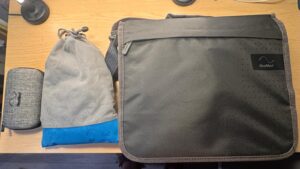
- ResMed AirSense 10 Case — the bag it came in, well recognised in airports as a CPAP device case
- Arden Industries Hose Lift — folds up compactly, lightweight, and holds the hose above head
- ResMed CPAP Wipes Tub
Travel CPAP Kit
- ResMed AirMini — the travel CPAP machine
- AirFit P10 for AirMini nasal pillows set — the AirMini has a different hose and connector type
- Genuine ResMed AirMini Travel Case — holds just the AirMini
- Arden Industries Hose Lift — compact when folded, lightweight, and holds the hose above head
- HumidX HME disks for the AirMini — I do not sleep well without one
- A generic AirMini to standard hose connector — in case a part breaks and I need to run a standard hose off the AirMini
- A silica gel sachet in the ResMed hard case, to take away any lingering vapour
Travel Batteries
- Easylonger EL240 — 88.8 Wh (now discontinued)
- Easylonger ES400 Air — 148 Wh, the one that needs airline approval
- Easylonger ES270 — 99.9 Wh, sent to me by Easylonger to test and review
Documentation
- Paperwork — a printed letter, a fit-to-travel letter where required, and the Easylonger battery documentation
How Do I Use a CPAP When Camping?
Turn humidification off, and the numbers change completely. ResMed’s published 53 W figure for the AirSense 10 is its typical consumption spec. That isn’t what the machine actually draws overnight with the humidifier off. My own AirSense 10 AutoSet runs three and a half nights on an Easylonger ES400 Air (148 Wh) without a recharge. That works out to roughly 42 Wh a night, not the 424 Wh its 53 W label implies. A ResMed AirMini on HumidX gets four and a half nights from that same ES400 Air, nearer 33 Wh a night.
The flying rules in this CPAP travel guide don’t apply here, so battery size stops being capped at 160 Wh. For longer trips, or a less efficient machine, a bigger battery makes more sense than juggling recharges. My father runs a Philips DreamStation Auto on an Easylonger ES720 (276.48 Wh) in a motorhome. He gets 4.5 nights with heating and humidification off, which works out near 61 Wh a night. He ran it flat at home first rather than finding out on a trip, and that is the right order to do it in. Easylonger’s own ES960 (297.6 Wh, LiFePO4 cells) is the next size up if you need more margin still.
ResMed states that humidification “consumes a great deal of power” and does not recommend it on battery. That matches what both of these real-world results show. Keep the battery inside the tent, since cold reduces lithium capacity.
How Do I Power a CPAP in a Caravan, Camper Van, Boat, RV or Motorhome?
Start with the fact that decides everything else: turn your machine over and read the label. It prints the voltage and current your machine expects, and the answer is not the same for everybody. All three ResMed machines want 24V. An AirSense 10 wants 24V at 3.75A, an AirMini 24V at 0.83A, an AirSense 11 24V at 2.71A. My father’s Philips DreamStation Auto is a 12V machine, at 6.6A.
That single number changes what you need. Your caravan, camper van or car runs at 12V. So a 12V machine can take that supply more or less directly, while a 24V machine cannot. Something has to step 12V up to 24V first.
That something is a DC to DC converter, and it is why ResMed sells one per machine. The Air10 DC/DC Converter 90W serves the AirSense 10. The AirMini DC/DC Converter 65W serves the AirMini. Both accept 12V or 24V input from a cigarette-lighter socket, then deliver 24V output to the machine.
The same rule governs battery choice, in two ways. First, a battery needs a genuine 24V DC output. That is why an ordinary USB power bank will not run either machine. Second, if the battery offers several output voltages, you must select 24V. My EL240 and ES400 Air both offer four settings, and only the top one is any use to a CPAP.
Skip the inverter where you can. Stepping 12V up to mains and back down to 24V inside the power brick wastes energy twice over.
Leisure Battery Use
Overnight draw, as your leisure battery sees it. A ResMed AirMini gets four and a half nights from a 148 Wh Easylonger ES400 Air. That works out to about 33 Wh a night, or under 3 Ah from a 12V leisure battery. A ResMed AirSense 10 with humidification off is not far behind. My own runs three and a half nights on the same ES400 Air, so roughly 42 Wh a night, or about 3.5 Ah. ResMed’s published 53W typical-consumption figure would suggest eight times that. Run it from the leisure battery, never the starter battery. For multi-night trips without hookup, an Easylonger ES720 (276.48 Wh) or ES960 (297.6 Wh, LiFePO4) buys more nights between charges. Neither is limited by the flight caps that apply elsewhere in this CPAP travel guide.
The practical routine my father uses is simpler than the numbers above suggest. On a site with electric hookup, he runs the CPAP straight off the mains power supply, no battery involved. Off-grid, he runs the ES720 instead, then recharges it from the vehicle while driving to the next site. That pattern avoids the DC-DC converter question entirely on hookup nights. And it means the battery only has to cover the nights actually spent off-grid.
Traveling With a ResMed AirSense 10
It travels well. The humidifier is what complicates it, not the power draw itself, and I run mine on battery routinely. ResMed publishes a weight of 1,248g with the cleanable tub, typical consumption 53W and peak 104W.
Enable Airplane Mode before you travel, always. If you use the humidifier, also empty the water tub and keep the empty tub inserted for flights. That mode disables the wireless modem and is not an altitude setting.
I own a ResMed AirSense 10 AutoSet and have never used humidification on it. That is worth saying, because the standard advice to switch humidification off on battery costs me nothing. It is already how I run the machine. In practice this gets me three and a half nights from a 148 Wh Easylonger ES400 Air, well below what ResMed’s published 53 W typical-consumption figure would suggest. If you do use humidification at home, the change will be more noticeable to you than it is to me.
I have traveled with my AirSense 10 around the United Kingdom, to Jersey in the Channel Islands, and on short-haul trips. For longer hauls, or when I am packing light, I take my travel CPAP.
Travelling With a ResMed AirSense 11
I do not own a ResMed AirSense 11, so this part of the CPAP travel guide is factual rather than first-hand. ResMed publishes 1,130g with the HumidAir 11 tub, and typical consumption of 56.1W. Peak draw is 73.2W, meaningfully lower than the AirSense 10’s 104W.
The travel-critical difference is the power supply: 24V / 2.71A against the AirSense 10’s 24V / 3.75A. That means battery DC cables are not interchangeable between the two machines. Buy the wrong cable variant and the connector will not fit.
Can I Use a ResMed AirSense 10 Humidifier When Flying?
This one only applies if your machine has a water tub. HumidX and other waterless setups have nothing to switch off. If you do use a tub: empty it, leave it inserted, and turn humidification off. ResMed’s warning is explicit: “Do not use the device with water in the humidifier on a plane due to the risk of inhalation of water during turbulence.”
ResMed’s three flight requirements are Airplane Mode enabled, humidification turned off, and the water tub “completely empty and inserted into the device.” Do not remove the tub — insert it empty. If dryness on a long flight is your concern, the ResMed AirMini’s HumidX Plus is designed for exactly that. ResMed even names aircraft as the use case. I use standard HumidX rather than Plus, so that is ResMed’s claim and not mine.