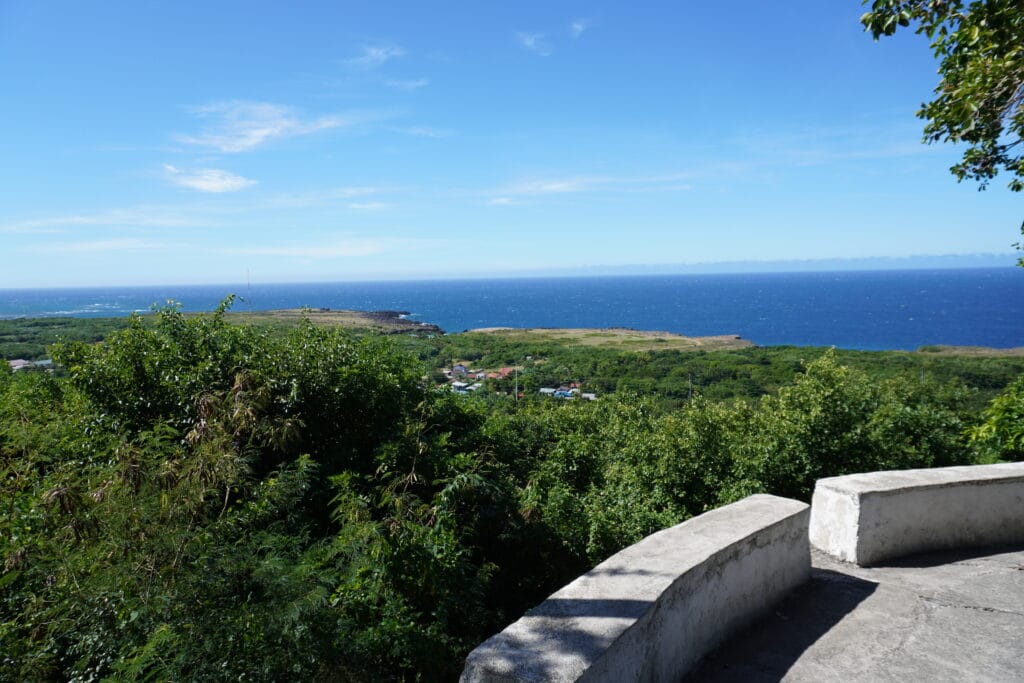
I expected Cape Bojeador Lighthouse to sit on a headland, but instead found it standing high 160m above sea level inland in Ilocos Norte.
The Road to Cape Bojeador Lighthouse
I visited Cape Bojeador Lighthouse in Ilocos Norte while travelling north along the Pan-Philippine Highway. We stopped roughly midway between Bobon and Burgos while heading to the Patapat Viaduct. I noticed the lighthouse sat far more inland than I expected.
On this last trip, I also noticed a new tourist spot under construction called Bannuar iti Amianan (Military Park Cape Bojeador) established by the 4th Marine Brigade a mile or so south of the base of the lighthouse hill in Burgos. While we couldn’t explore it on this visit, it looks like a fascinating stop for history buffs, featuring decommissioned military aircraft and vehicles. I’ll be sure to check it out and provide a full update on my next Ilocos adventure! Although we did stop at another Ilocos Norte tourist spot on the way to Cape Bojeador, a Filipino Salt House at Pasuquin, on the Pan-Philippine Highway, just south of Burgos.
I usually associate lighthouses with exposed coastal headlands. Cape Bojeador Lighthouse sits instead on a hill called Vigia de Nagparitan (Vigia is the Spanish word for watchtower or look-out, de is of, and Nagparitan is the place name, near to Burgos: ‘Look-out of Nagparitan’. The site rises around 160 metres above sea level. From that height, it looks out toward the South China Sea.
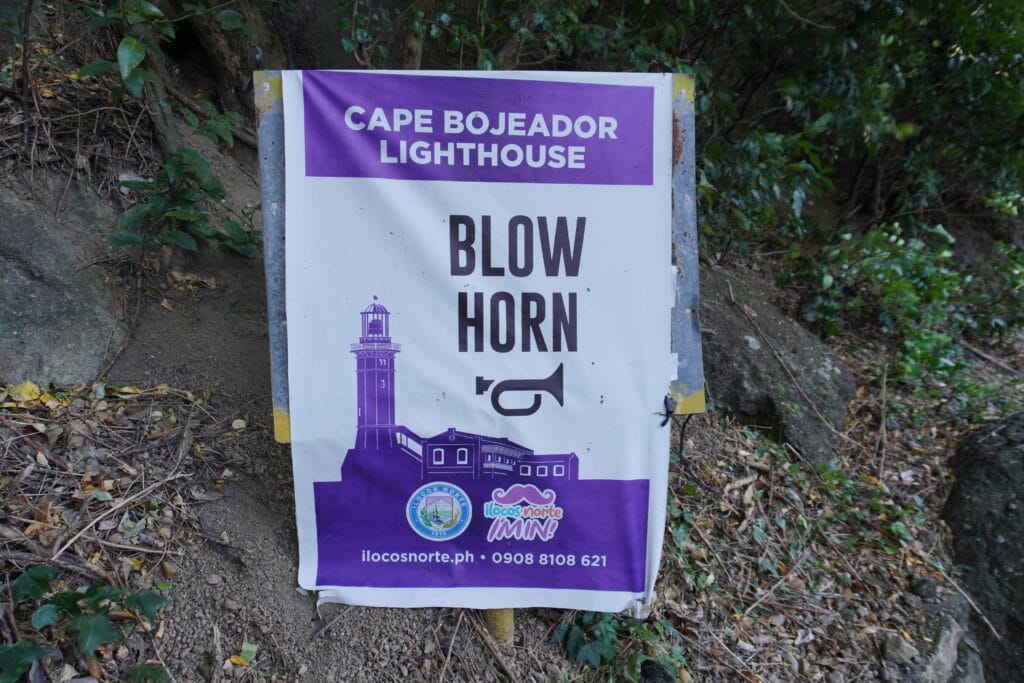
A steep road climbs from the highway up the hillside. We used a minivan, so I avoided walking in the heat. The road winds up to just below the lighthouse. Although you will have to park at the Pasalubong Center then walk the short incline to the base of the lighthouse. If you cannot then tricycles will take you up for 10 – 50 pesos per person. Since no vehicles are allowed up to the top.
Cape Bojeador Pasalubong Center
We passed the Cape Bojeador Pasalubong Center on the way up. The centre sits partway up the access road, not at the top. I treated it as a practical stop rather than a main attraction.
Pasalubong refers to gifts brought home after travel. People often use the word for souvenirs or local treats. The centre groups several small shops in one place.
Local sellers offer handmade crafts and regional delicacies. I also found bottled water and cold drinks, which helped in the forty degree celsius heat. The centre also offers free parking, which makes stopping easy.
From the centre, visitors can continue uphill toward the lighthouse. Some people walk from this point to manage the climb in stages. Others take a tricycle if the heat makes the ascent difficult.
Lighthouse History and Architecture
Cape Bojeador Lighthouse first operated in 1892 and continues to operate today under management of the Philippine Coast Guard. Spanish colonial authorities included it in their 1857 master plan to illuminate the Philippine archipelago, with a focus on Northern Luzon shipping routes.
Spanish colonial engineer Magin Pers y Pers designed the lighthouse as part of this programme. His work aimed to prevent Spanish galleons from striking dangerous and unlit headlands along the coast. He later designed additional lighthouses in Cagayan, Zambales, and Mindoro.
Pers y Pers did not complete construction at Cape Bojeador Lighthouse. Guillermo Brockman later finished the project while serving as chief engineer of the Lighthouse Services. Brockman held that role between 1856 and 1930.
Builders constructed the lighthouse using brick, lime mortar, wood, and metal. Capiz shell windows sit behind original timber shutters. I was reminded of the traditional capiz shell windows I saw in Historic Vigan City, another Spanish colonial site that blends local and colonial architectural details.
The tower follows an octagonal plan built from tapered brick masonry, which tapers in then back out again, its design has stood the test of time and endured the intense 1990 Luzon earthquake, which damaged its original Fresnel lens and displaced its mechanism, yet the tower remains standing and in service today. The Romanesque style reflects European engineering adapted to local conditions.
In recognition of its significance, the Philippine government recognised the lighthouse as a National Historical Landmark in 2004 and a National Cultural Treasure in 2005, as documented by the National Museum of the Philippines.

Continuing north towards Bangui and Pagudpud, another useful stop along this route is 18 Degrees North in Bangui, where we stopped for brunch and explored the camping and glamping area.
FAQ’s
During my visit, the access road continued uphill to just below the lighthouse. Larger vehicles stopped at the Pasalubong Center, while tricycles only continued further up the hill.
The Cape Bojeador Lighthouse is 20 metres tall and sits on a hillside about 160 metres above sea level in Ilocos Norte.
During my visit the lighthouse was not open to the public, but it can be viewed from the base. There was no fee unless you took a tricycle to the top, in which case the drivers charge 10 – 50php per person each way. Getting down is a lot easier than getting up though!
Yes. At the Cape Bojeador Pasalubong Center, adjacent to the parking area, there are several stores selling ice cold water and bottled drinks and local snacks.