Ilocos Norte tourist spots include heritage salt making, where waste rice and coconut husks are used as fuel to create embers.
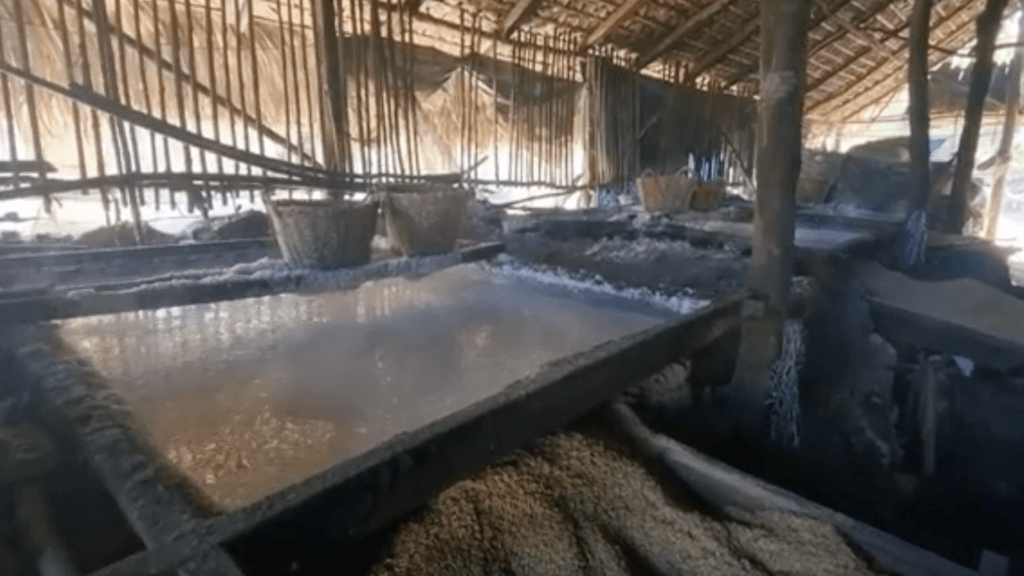
Evaporation Method Salt Making in Pasuquin
Traditional salt making in Ilocos Norte offers a rare look into a working coastal industry. It blends culture, necessity, and adaptation. During my visit, I explored salt farms along the Pan-Philippine highway in Pasuquin and Burgos Ilocos Norte, where the process differs from standard sun-drying evaporation methods.
Unlike typical salt flats, or coastal evaporation tanks, this method uses heat and filtration. As a result, it reflects both resourcefulness and local conditions. This makes it particularly interesting for Western travellers visiting both Laoag City and the wider area of Ilocos Norte, and exploring the wider Northern Luzon region.
The process begins with preparing a base material. Locals finely grind rice husks and coconut husks, then place them into a raised earth oven. This stage forms the foundation of the Pasuquin-style salt production method in Ilocos Norte.
Although modern equipment exists, this traditional approach remains widely used. In many coastal areas such as Saoit Ilocos Norte, access to machinery is limited. Therefore, this method continues to support small businesses that can scale their salt production using available resources.
Ilocos Norte Tourist Spots Featuring Salt Making
Next, the process shifts from preparation to extraction. Workers combine seawater with imported Australian salt crystals. The mixture is then brought to a controlled boil.
As the water evaporates, salt concentration increases. Workers leave the mixture to cool naturally over smouldering cinders until the salt dries into lumps, then they break it up. This stage ensures the formation of usable salt crystals.
Mineral Enrichment of the Sea Salt
In line with Philippines health regulations, more commonly known as the ASIN Law (Republic Act No. 8172). It is a mandatory requirement since 1995, that all producers and manufacturers, or importers of food-grade salt whether for human or animal consumption, must iodize their products. Therefore, iodine is sprayed onto the salt once the water has been evaporated. This step helps prevent iodine deficiency, and combat micronutrient malnutrition which remains a concern across the Philippines.
Drying and Packaging Sea Salt for Sale
Once treated, the salt undergoes thorough drying. This ensures consistency and shelf stability. After drying, workers pack the salt into clear plastic bags and distribute it across markets in Laoag City and nearby towns.
I saw almost all store owners sell the salt on racks outside their Sari-Sari stores along the Pan-Philippine Highway, but the salt houses will also sell it directly.
Cultural Importance in Northern Luzon
This method highlights more than production. It represents a continuation of regional identity. In Pasuquin and Burgos, salt making is not just an industry. It is part of local filipinos daily life. These are working cultural traditions that still matter. Consequently, this experience adds depth to any Northern Luzon itinerary.
For western travellers, this is not a staged attraction. It is a functioning, local tradition. Therefore, it provides a more genuine understanding of Philippine coastal communities.
I found that visiting a salt farm adds real context to the livelihoods in this area of Luzon, and if it’s not the salt production you notice, your senses will certainly pick up the aroma of garlic being grown nearby also. The locals invited me inside and showed me their trade. However, I should warn you, it gets incredibly hot inside a salt house because of the outside humidity coupled with evaporating steam and the burning husk fires, although I found it great for opening the skin pores.
Other Cultural Travel and Ilocos Norte Tourist Spots
For visitors, this offers a different perspective. Beyond the beaches or Blue Lagoon and Saud Beach (pronounced Sah-Ud), you will also find other worthy tourist spots and attractions to visit like Cape Bojeador Lighthouse, the Bangui Windmills, and the nearby Kapurpurawan Rock Formation.
If you are staying in or near Laoag City, I recommend visiting Paoay, where I saw the famous UNESCO World Heritage Site of Paoay Church. If you are travelling through Bangui or Saoit, we stopped for brunch and coffee at ‘18° North Camping Cafe and Diner‘ (and you might even see the wooden placard they asked me to write on display) on the way to the Patapat Viaduct in Pagudpud.