Whether you need a doctor’s letter to fly with a CPAP depends mostly on your airline, and on whether you plan to use the machine on board.
Last Updated: 14/11/2026
Does Airport Security Ask for a Doctor’s Letter?
In the US, the Air Carrier Access Act rules at 14 CFR 382.133 accept a CPAP that displays the manufacturer’s label showing it meets FAA requirements. Those rules cover US airlines and foreign airlines on any flight to or from a US airport, so it is worth checking your machine for that label before you fly.
The TSA, in the US, says you may give an officer a notification card or other medical documentation to describe your condition, which leaves the paperwork up to you, although TSA also makes clear that showing a card or letter will not exempt you from screening.
In the UK, GOV.UK lists CPAP machines as medical equipment you can take in your carry-on or checked bag, and it asks for proof such as a doctor’s letter or a copy of your prescription only for liquid medicines in containers over 100 ml.
However, the Northern Ireland government’s NI Direct page goes further for medical equipment, stating that “you must show documents from a qualified medical professional” and giving a letter from your doctor as the example. Since the two UK government websites do not agree, a letter is worth carrying when you fly from a UK airport, even though GOV.UK itself does not ask for one.
Which Airlines Ask for Medical Paperwork?
Airlines are a different matter, because each one writes its own policy, and most of them tie the paperwork to using the machine in flight rather than simply carrying it. The airlines below are the ones I have checked so far that publish a paperwork requirement for CPAP users, quoted from their own websites, and I add more as I check them.
| Airline | What It Asks For | When It Applies |
| Air New Zealand | “Air New Zealand MEDA form Part 1 must be completed for anyone wishing to use a CPAP on-board.” | Using it on board, with 48 hours’ notice |
| Cathay Pacific | MEDA clearance before you use the machine | Using it on board, with 48 hours’ notice |
| Qatar Airways | CPAP is a MEDIF category: “Approval from QR Doctor on MEDIF is required.” | MEDIF between seven days and 48 hours before departure |
| Singapore Airlines | “You must also provide a medical certificate from your physician to indicate your fitness to travel.” | Electrical medical equipment, with 48 hours’ notice |
| Turkish Airlines | “A doctor’s certificate is required if the passenger intends to use the portable respirator in the cabin.” | Using it on board, with 48 hours’ notice |
| Wizz Air | Fit to Fly form, “issued within 6 days of the flight date” | Using it on board; carried switched off without one |
| Air Europa | “a medical certificate issued within 10 days of the flight’s departure” | Using it on board |
| Norwegian | “you may be required to provide us with a medical certificate to confirm that you’re fit to fly” | Using it on board; certificate under 10 days old |
| EgyptAir | “The customer must hold a Medical Information Form (MEDIF), filled and completed by his doctor.” | Flying with a CPAP |
| Eurowings | “Boarding and carriage are not permitted without previous registration and a certificate of air travel fitness.” | Carrying it at all, with 72 hours’ notice |
| South African Airways | Medical clearance, with “Carriage of medical equipment” listed as a trigger | Carrying it, with 48 hours’ notice |
| Hawaiian Airlines | Physician verification form, with CPAP named | Carrying it |
| Gulf Air | No clearance for sleep apnea, but you “must carry a letter from their own doctor” | Flying with a CPAP, with 48 hours’ notice to Gulf Air Reservations |
| Aurigny | Doctor’s letter “required for security clearance” | Carrying it through security |
Eurowings, South African Airways, Hawaiian, Gulf Air and Aurigny stand out, because their paperwork applies even if the machine stays switched off in its bag for the whole flight.
If you plan to sleep with the machine running, my post on using a CPAP on a plane covers batteries and the rest of the in-flight setup, while my CPAP airline policy post quotes each airline’s notice periods alongside the paperwork.
Which Airlines Say No Medical Clearance Is Needed?
At the other end, several of the airlines I have checked so far state plainly that a CPAP user needs no medical paperwork, as long as the machine itself meets their conditions.
| Airline | What It Publishes |
| British Airways | “Medical clearance is not needed to travel with or use a CPAP Machine for sleep apnoea on board our aircraft.” |
| easyJet | Does “not require a letter from your healthcare practitioner” for CPAP machines |
| Aer Lingus | “We allow the carriage and use of approved medical devices which do not require pre-clearance or a medical form to be completed in advance.” |
| Emirates | A MEDIF is generally not required for “the carriage or use of an approved CPAP/PAP device for the treatment of obstructive sleep apnea” |
| Etihad | “Prior medical clearance is not required to carry or use a CPAP/BIPAP device on board, provided the following conditions are met” |
| Frontier | “A medical authorization is not required for respiratory devices.” |
| Japan Airlines | “When using CPAP, you do not need to show a prescribed medical certificate.” |
| ANA | “Issuing a Medical Information Form (MEDIF) is not required for the use of the device.” |
Even on these airlines, a letter can still help at security in another country, because the airline’s own policy does not decide what a screener at a foreign airport asks to see.
Doctor’s Letter, MEDIF or Fit to Fly Certificate: What Is the Difference?
Airline policies use several names for medical paperwork, and each one means a different document, so it helps to know which one a policy wants before you ask your doctor.
A doctor’s letter comes from your own doctor or sleep clinic and confirms your diagnosis and that you use a CPAP every night, and it carries no expiry date unless an airline sets one.
A MEDIF, short for medical information form, is the airline’s own form, which your doctor completes before the airline’s medical team approves it. Airlines name it differently, so look out for a MEDA form on Air New Zealand, Cathay Pacific and El Al, or a medical clearance form on Air China.
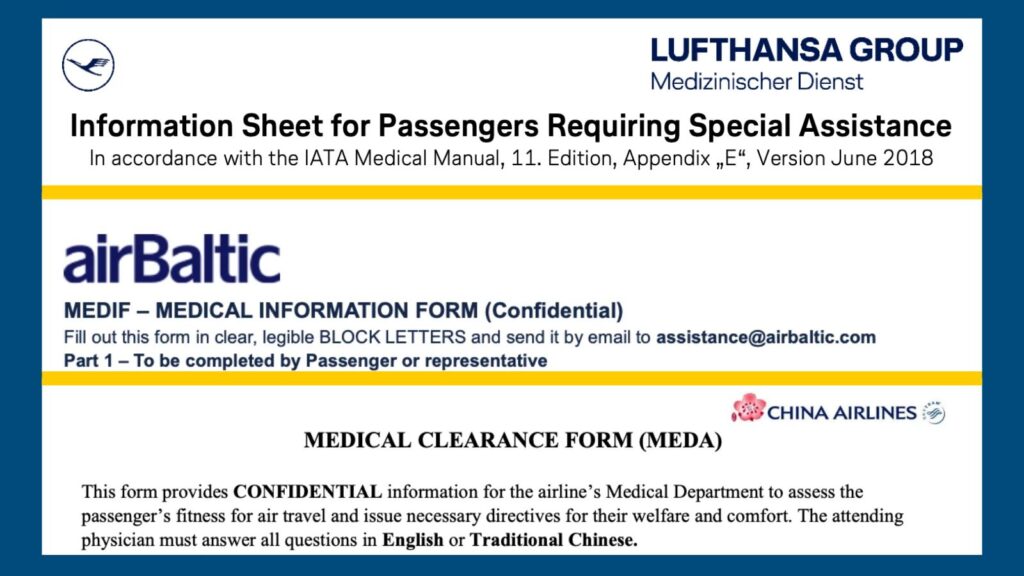
A fit to fly certificate is a dated statement from a doctor that you are well enough to travel, and the airlines that want one usually set a time limit, such as six days on Wizz Air or ten days on Air Europa and Norwegian.
For that reason, ask for a fit to fly certificate close to your departure date rather than weeks ahead, otherwise it may be out of date by the time you check in.
Should I Carry the Manufacturer’s FAA Compliance Letter?
Some airlines care less about your diagnosis than about the machine itself, since they want proof that it meets FAA requirements for use on an aircraft. Etihad, for example, lets you carry or use a CPAP without medical clearance as long as it has the manufacturer’s FAA label or a compliance letter, and Gulf Air asks for the same label or letter before you use the machine on board.
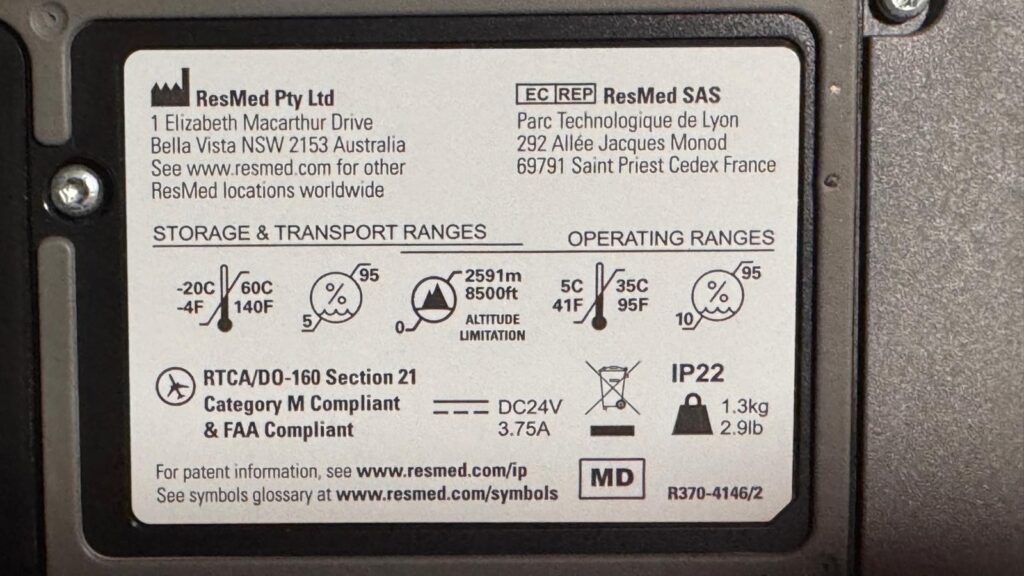
ResMed publishes a travel compliance letter stating that the machines it lists “comply with RTCA/DO-160G, Section 21, Category M, and are considered FAA compliant.” The letter lists both the AirMini and the AirSense 10 by product code, and you can download and print the current version from ResMed’s travel page.
If your machine comes from another manufacturer, read the label on your own CPAP for a statement that it meets FAA requirements, and ask the maker for its compliance letter if you cannot find one.
Does a Doctor’s Letter Help You Carry a CPAP Bag for Free?
It can, because the UK Civil Aviation Authority tells travelers to let their airline know in advance if medical equipment is likely to take them over their carry-on allowance, and adds: “You may need to provide a doctor’s letter to support this.”
Ryanair takes a different approach, since it carries a CPAP on top of your allowance only once you hold its own medical baggage waiver letter, and its page states that “Only items listed in the waiver letter will be accepted for carriage free of charge.”
In the US, the Department of Transportation states that “Assistive devices do not count to your baggage limit,” although it adds that a bag also holding personal items can count, so keep the CPAP bag for the machine and its accessories only.
What I Carry When I Fly With My CPAP
I just find it easier to carry a copy of my doctor’s letter together with my CPAP battery documentation in a plastic wallet. It’s better to have it, just in case, and it takes up no space in the zipped pocket on my CPAP bag.
In my experience, airport security does not ask for a doctor’s letter. Depending on the airport, staff sometimes ask me to take the CPAP machine out of the bag and leave the hose and mask inside, while at other times they recognize the bag and tell me to leave everything together.
If you keep your documents in the CPAP bag itself, its kept together with the device. Importantly, because the CPAP bag looks like everyone else’s in the overhead bin, my free printable CPAP luggage tags have space for your name, contact email and/or number and battery rating. An email address works better for international travel, because you may not have roaming enabled while using a data-only eSIM, so someone can still contact you if your bags do inadvertently get mixed up.
For everything else about the trip, from carry-on rules to powering the machine at your destination, see my CPAP travel guide.
The Time My CPAP Bag Was Searched at Jersey Airport
I had one funny experience at airport security in Jersey, Channel Islands, before a British Airways flight. As I was traveling carry-on only, I had put a small Jersey guidebook in the front pocket of my CPAP bag. When the bag went through the scanner, it was immediately ejected, and I was taken out of the line for a search because staff thought I was carrying something illicit.
I was pretty confused about why they were asking me all these questions, until they opened the zip pocket and the airport police pulled out a guidebook to their own island. I said, “You can keep it if you want!” Once they had laughed about what the dense rectangular object turned out to be, my CPAP bag went back through with no issues, and they let me keep the guidebook.